








Buying a home is not only about checking its price, size or physical condition. It is also necessary to confirm that it can legally be used as a dwelling and that the completed construction matches what was authorised.
The first occupancy licence is one of the documents that make it possible to certify this situation. In Andalusia, however, many cases are currently processed through a responsible declaration of occupancy or use. Therefore, before buying it is not enough to ask whether the property “has a licence”: you need to identify which authorising title corresponds to it, check its content and verify that it remains valid for the property being acquired.
Short answer: the first occupancy licence certifies, as a general rule, that a completed building may be used for its intended purpose and that it complies with the applicable planning and technical requirements. In Andalusia it may be replaced, in certain cases, by a responsible declaration submitted with all the required documentation. In a purchase, the document, the municipal file, the correspondence with the property and the possible existence of subsequent works or changes must all be reviewed.
What the first occupancy licence is
The first occupancy licence is the municipal title that has traditionally allowed a building to be used for the first time after the works are completed. Its purpose is to verify that the construction has been carried out in accordance with the authorised project, that it is finished and that it may be used for its intended purpose.
It should not be confused with the building licence. The building licence allows construction or refurbishment under certain conditions. The occupancy licence relates to the later stage: the possibility of legally using the building once it is completed.
Depending on the regulations and on the file, the verification may include:
- The correspondence between the works carried out and the authorised project.
- The effective completion of the works.
- The final works certificate.
- Compliance with the conditions set out in the licence.
- The suitability of the intended use under planning regulations.
- The availability of the necessary technical documentation.
- The situation of the utilities and installations.
- The correct execution of the common elements when they form part of the works.
This document does not guarantee that a construction defect will never appear, nor does it replace an independent technical survey. It also does not remove the need to review the Land Registry, the Cadastre, the charges, the owners' association and the rest of the legal documentation of the purchase.
What it is for before buying a home
From the buyer's perspective, the licence or equivalent title helps to confirm that the property may be used for the purpose advertised.
Its importance appears at several moments:
- On handover of a new-build home.
- When definitively contracting utilities.
- When declaring a completed new building.
- When applying for financing.
- In a future sale.
- In certain rental or tourist letting procedures.
- When checking the planning legality of the property.
Andalusian regulations establish that utility companies may require the licence, responsible declaration or relevant title in order to definitively contract services such as water, electricity, gas or telecommunications.
This does not mean that any home with utilities necessarily has all the correct documentation. A property may retain old contracts or present a situation that was never fully reviewed. The existence of water and electricity is a useful indication, but it does not replace checking the municipal file.
First occupancy licence or responsible declaration in Andalusia
In Andalusia it is necessary to distinguish between the term buyers usually employ and the legal instrument that may currently correspond to the property.
Law 7/2021, on Promoting the Sustainability of the Territory of Andalusia, subjects the following cases, among others, to a responsible declaration:
- The occupancy of buildings covered by a licence or responsible declaration for works, when they are completed, comply with what was authorised and their intended use conforms to the regulations.
- The occupancy of certain existing buildings located on urban land, when they conform to the planning in force or are legally outside the planning framework and have not been subject to works.
The responsible declaration allows occupancy to begin from the moment it is submitted, provided it is correctly completed and accompanied by all the required documents, certificates and authorisations. It is not the equivalent of filing an empty form, nor does it eliminate municipal control.
The Town Hall retains its powers of verification, inspection and control. If the documentation contains essential omissions or false data, or if the property does not meet the necessary requirements, the Administration may declare the declaration ineffective, order the cessation of occupancy and initiate the corresponding actions to restore legality.
In Marbella there is a specific municipal procedure for the responsible declaration of first occupancy. For this reason, when reviewing a property in this municipality the correct document may not be a licence granted through a traditional resolution, but a responsible declaration submitted with its corresponding technical file.
The right question is not only “does it have a first occupancy licence?”, but:
- Which authorising title corresponds to this property?
- Was it submitted correctly?
- Did it include all the necessary documentation?
- Did the Town Hall issue any formal request?
- Is the declaration still effective?
- Does it match the property being sold?
- Were subsequent works carried out that modified what was declared?
Since when the first occupancy licence has been compulsory
There is no single date allowing one to state that all homes built before a specific year are exempt and that all later ones need exactly the same document.
The first use of buildings was already subject to a licence under national land legislation from 1956. Subsequently, the autonomous regions and the municipalities developed their own systems, names, procedures and equivalent documents.
In Andalusia, earlier planning legislation already provided for the occupancy licence. The current system is found mainly in Law 7/2021 and in its General Regulation, approved by Decree 550/2022, which introduce and develop the responsible declaration for certain cases.
Therefore, in order to answer correctly the query about since when the first occupancy licence is compulsory, the following must be analysed:
- The date the building was completed.
- The regulations in force at that time.
- The municipality where it is located.
- The type of land.
- The original use of the property.
- The licences and authorisations granted.
- Any works or changes of use carried out afterwards.
- The existence of equivalent documents or special regimes.
Age should not be used as an automatic conclusion. The fact that a home is old does not necessarily mean it is illegal, but neither does it allow any absence of documentation to be taken as valid.
First occupancy licence for older homes
The absence of a copy of the licence is relatively common in homes built decades ago. The document may not be among the owner's records, may have been lost during previous transfers or may never have been digitised.
The first step should be to consult the municipal file. If the licence was granted at the time, it may be possible to obtain a copy or a certificate proving its existence.
When no first occupancy licence appears for older homes, it is necessary to determine why it is missing. Very different situations may exist:
- The licence was granted, but the owner does not keep the copy.
- The file is old and incomplete.
- The home was built under earlier regulations.
- The building has another document allowing its occupancy.
- Extensions or refurbishments were carried out that are not reflected in the original project.
- The home is legally outside the planning framework.
- The building is in the situation known as assimilated to being outside the planning framework.
- There are planning infringements in respect of which certain restoration measures can no longer be adopted.
- The property never obtained the necessary title.
In Andalusia there are specific regimes for certain older buildings. The legislation provides, for example, for administrative certifications relating to constructions completed before Law 19/1975 came into force, and for other historical cases. This does not mean that all old homes are automatically regularised.
A distinction must also be drawn with the recognition of assimilation to being outside the planning framework, known as AFO. The Regional Government of Andalusia expressly clarifies that AFO recognition does not legalise the building nor is it equivalent to holding a licence. It is a different instrument that identifies a specific planning situation and sets out the conditions under which the property may be maintained and access certain services.
To review an older home it is advisable to request:
- The municipal planning file.
- The original building licence, if it exists.
- The occupancy licence or equivalent document.
- A descriptive and graphic technical certificate.
- The title deed and an updated Land Registry extract.
- The cadastral information.
- The authorised plans.
- The documentation of later extensions and refurbishments.
- The applicable planning situation.
- The utility connection records.
- Any municipal certificates of age or legal status.
If the physical, registry and cadastral surface areas do not match, it will be necessary to understand the origin of the difference before signing. Not all discrepancies carry the same weight or are resolved in the same way.
First occupancy licences: what the buyer should check
First occupancy licences and responsible declarations must be reviewed in relation to the specific property. Simply checking that a document with that name exists may lead to incorrect conclusions.
Before buying it is advisable to verify:
The identification of the property
The document must correspond to the plot, dwelling, entrance, floor, number and phase being acquired. In large developments there may be different licences or declarations for each block or stage.
The annexes
The garage, storage room, pool, gardens and other communal areas may form part of different files or phases. It is necessary to confirm which elements are included and which remain pending.
The surface area and layout
The actual configuration of the home must match what was authorised. Enclosing a terrace, extending a room, building a basement or making a subsequent structural alteration may have changed the original situation.
The date and conditions
It is necessary to check when the licence was granted or when the declaration was submitted, whether conditions were imposed and whether there are outstanding municipal requirements.
The technical documentation
The responsible declaration must be accompanied by the required certificates and documents. Submitting the form does not protect the buyer if essential documents are missing or if their content does not match reality.
Subsequent works
A home may have correctly obtained its initial licence and later undergone works without authorisation. A historical licence does not automatically make all subsequent modifications legal.
First occupancy licence or certificate of habitability
The search for first occupancy licence or certificate of habitability usually starts from the idea that these are two names for the same document. They are related, but they are not always equivalent.
The first occupancy licence has a mainly planning-related and municipal dimension. It verifies that the completed building may be used for its intended purpose and that it complies with the applicable conditions.
The certificate of habitability certifies that a home meets certain minimum conditions to be inhabited. Its use, validity and procedure depend on the autonomous region.
In some Spanish regions the certificate plays a central role. In Andalusia, for a purchase in Marbella or on the Costa del Sol, the usual practice is to review the occupancy licence, the responsible declaration or the corresponding equivalent municipal document.
A document of a different nature should not be accepted simply because it includes the word “habitability”. A technical certificate, a utility connection record, a cadastral reference or a registry entry may provide information, but on their own they do not replace the required planning title.
Is there a fine for living without a first occupancy licence?
There is no automatic, single fine applicable in all cases simply because the owner cannot find a copy of the document.
To determine whether a fine may be imposed for living without a first occupancy licence, it is necessary to check:
- Whether the property needed a licence, a responsible declaration or another title.
- Whether the document exists even if the owner does not keep the copy.
- Whether the building has an equivalent regime.
- Whether the occupancy conforms to or contravenes the planning framework.
- Whether incorrect or incomplete documents were submitted.
- Who carried out the works and who may be held responsible.
- Whether there are previous municipal requirements.
- The seriousness and specific circumstances of the infringement.
Andalusian legislation generally considers serious certain works carried out without the necessary licence or without submitting the mandatory responsible declaration. Law 7/2021 establishes fines of:
- 600 to 2,999 euros for minor infringements.
- 3,000 to 29,999 euros for serious infringements.
- 30,000 to 120,000 euros for very serious infringements.
In certain cases the fines may also be calculated in relation to the value of the works, the land or the damage caused.
These amounts do not support the conclusion that anyone living in a house without keeping the licence will receive a specific penalty. The classification depends on the file and on the conduct deemed to constitute the infringement.
In addition to a possible penalty, the Administration may adopt measures to restore legality, declare a responsible declaration ineffective or order the cessation of occupancy when the property does not meet the necessary requirements.
For this reason, if the document is missing, the priority should not be to calculate a hypothetical fine, but to identify the actual planning situation and the possibilities of remedying it.
What problems the lack of documentation may cause
Even where there is no automatic penalty, buying a home without clarifying its occupancy title may have practical and financial consequences.
Utilities
Andalusian regulations allow companies to require the authorising title in order to definitively contract water, electricity, gas or telecommunications. The existence of previous utilities does not guarantee that they can be transferred or reactivated without incident.
Financing
The bank and the valuation company may request additional planning documentation. A lack of clarity may affect the valuation, delay the transaction or prevent final approval of the mortgage.
Future sale
A problem the buyer accepts today may reappear when they want to sell. The next buyer, their lawyer or their bank may require documents that were not reviewed in the previous transaction.
Renting
The absence of the appropriate title may affect the possibility of legally letting the property, especially where the intention is to carry out a tourist activity subject to additional requirements.
Insurance and liability
In the event of a claim, a serious discrepancy between the physical reality and the documentation may complicate the determination of liability and cover.
Regularisation costs
Remedying the situation may require technical reports, fees, works, registry amendments, planning procedures, or it may not even be possible on the terms expected.
How to check whether a home has a first occupancy licence
The check should be carried out before handing over significant amounts or signing a contract that limits recovery of the deposit.
A reasonable process includes:
- Requesting the document from the seller or the developer.
- Checking that it identifies the property and its annexes exactly.
- Reviewing the building licence and the final certificate.
- Consulting the file at the Town Hall.
- Confirming whether a responsible declaration exists together with all its documentation.
- Reviewing any subsequent requirements or resolutions.
- Comparing the physical reality with the authorised plans.
- Verifying the Land Registry and the Cadastre.
- Analysing refurbishments, extensions or changes of use.
- Requesting an independent technical and legal review where there are doubts.
In a new-build home it is also advisable to check whether the title covers all the communal areas promised and whether there are phases still pending. The possibility of occupying a home does not necessarily mean that the whole development is finished.
What to do if the property does not have the document
The first decision should be neither to reject the property automatically nor to accept verbal explanations. The reason for the absence must be identified.
Depending on the case, it may be necessary to:
- Request a copy of the municipal file.
- Obtain an administrative certificate.
- Submit a responsible declaration accompanied by the technical documentation.
- Legalise certain works.
- Correct discrepancies between reality, the Land Registry and the Cadastre.
- Process a recognition of the planning situation.
- Require the seller to resolve the problem before completion.
- Include specific conditions and guarantees in the contract.
- Withdraw from the purchase if the risk cannot be defined.
A seller's promise to “sort it out later” does not offer the same protection as a contractual condition with clearly defined deadlines, obligations and consequences.
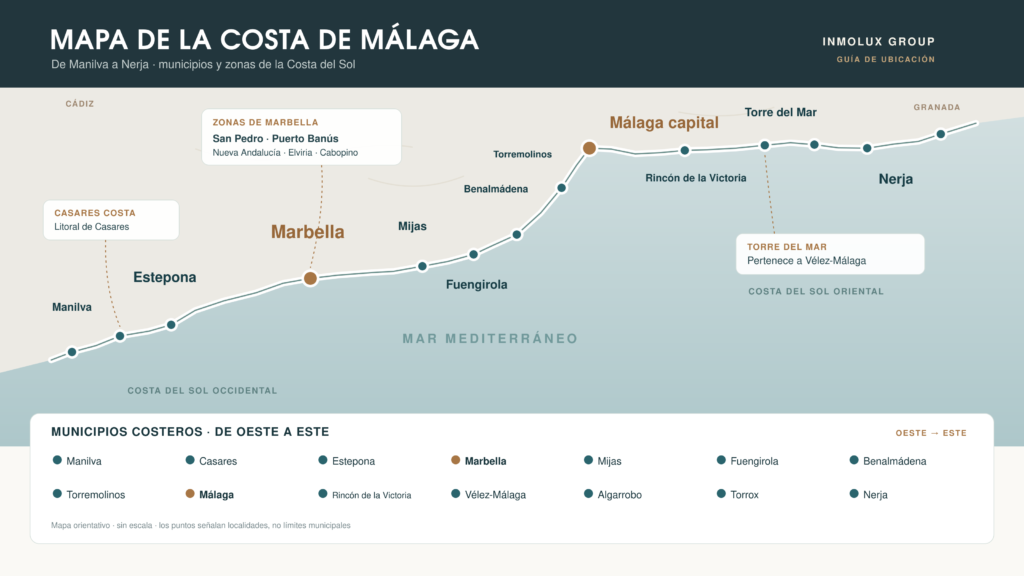
What to check in particular in Marbella and on the Costa del Sol
In Marbella and other municipalities on the Costa del Sol, new builds coexist with homes constructed decades ago, refurbished properties, extensions, buildings developed in phases and homes located on different classes of land.
This diversity makes it necessary to analyse each property individually. Two villas built in the same decade may have completely different documentary situations.
Before buying it is advisable to ask:
- Which title allows the property to be occupied.
- Whether there is a licence or a responsible declaration.
- Which authority and which file certify it.
- Whether the current surface area matches the authorised one.
- Whether the terraces, basements, pools and annexes are documented.
- Whether subsequent works were carried out.
- Whether the property is outside the planning framework or in an AFO situation.
- Whether the communal areas are finished and authorised.
- Whether the utilities are definitive.
- Whether the use intended by the buyer is compatible with the existing situation.
An attractive home may still be a bad purchase if the use the buyer needs is not sufficiently protected. Real value lies not only in what is seen during the viewing, but also in the documentation that makes it possible to use, finance and sell the property with greater security.
Buying with the documentation reviewed
The first occupancy licence should not be analysed as an isolated formality. It forms part of a broader review that includes the planning situation, the Land Registry, the Cadastre, the plans, the charges, the owners' association, the refurbishments and the use the buyer wishes to give the property.
At Inmolux we do not begin solely by finding properties that fit a budget. First we understand how the home will be used and which risks the buyer is not willing to take on. We then select and review the options with a clear hypothesis of fit.
The aim is not to accumulate documents, but to understand what each one certifies, what is missing and how it may affect the decision before the money is handed over.
This article contains general information and does not replace legal, planning or technical advice applied to a specific property.